Crows in the House and on the Horse!

Some birds aren’t that scared of people and will hang out near the house. Like this cute little maya or Eurasian Tree Sparrow.

_E7A7159

And then there are crows. I confess that I used to sit around thinking of schemes to get rid of the crows. Crows have a bad reputation. They eat other birds. They steal eggs from nests. Other birds mob them and try to drive them away. They are associated with witches and bad omens.

They are also very intelligent birds. They are part of the corvid family. There are studies that show corvids using all kinds of tools, remembering the faces of researchers at a university and then attacking them when they saw them in the campus, and solving complicated problems such as dropping pebbles into a container of water so they can get a sip of water just like the Aesop’s fable!

Now that I’m not scared of them or trying to drive them away, I can just watch them.

There’s a murder of crows that hangs out at the horse house.

_E7A6012

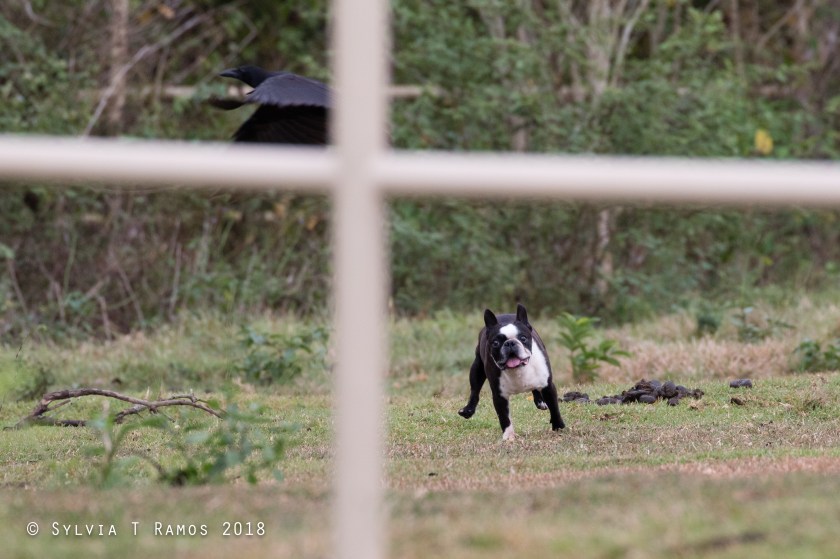
What would happen if Barkley entered the horse paddock? Would they attack Barkley?

_E7A7169

Ha! Barkley didn’t even feel threatened.

_E7A7171

They are no match for Barkley and just leave him to do his thing in the paddock.

_E7A7172

I thought it was so nifty when I saw a crow drinking from the horses’ water trough. I ran back to the house so I could take a photo.

_E7A6017

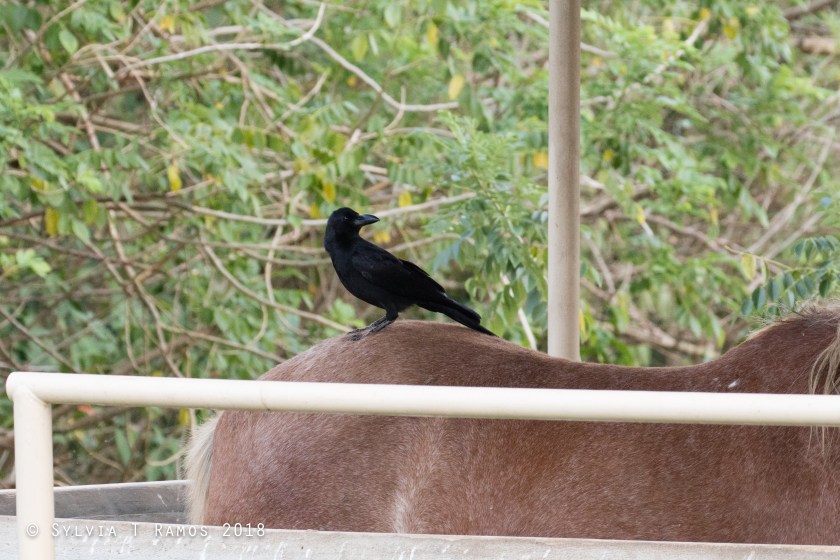
And then the other day I couldn’t believe my eyes. Was the crow really standing ON Takoy’s back?

_E7A7302

Yes, he was! And Takoy wasn’t bothered at all!

_E7A7305

The crow stayed there for a long time. What was going on? Was he going to groom Takoy? Get a bug from Takoy’s back like those Oxpeckers and Rhinoceros in Africa? Walk behind Takoy waiting for him to unearth bugs from the grass like a Cattle Egret and carabao? Grab some feed from Takoy’s bucket? I didn’t see anything like that, the crow just flew away. But who knows what I’ll see next time!


Farm Bird List as of March 2018

These are all the species we have seen at the sanctuary over the years, with notes on recent sightings.


Common Name Scientific Name Notes on recent sightings
1 Wandering Whistling Duck Dendrocygna arcuata
2 Philippine Duck Anas luzonica had our highest count in January, 23 birds at one time
3 King Quail Excalfactoria chinensis
4 Red Junglefowl Gallus gallus
5 Cinnamon Bittern Ixobrychus cinnamomeus was common in 2017
6 Black-crowned Night Heron Nycticorax nycticorax not common, first seen in August 2017
7 Striated Heron Butorides striata
8 Eastern Cattle Egret Bubulcus coromandus
9 Grey Heron Ardea cinerea
10 Purple Heron Ardea purpurea there’s one individual in the picnic area
11 Great Egret Ardea alba
12 Intermediate Egret Ardea intermedia there was one very close to the cottage in March, might have gotten blown in with the strong wind
13 Little Egret Egretta garzetta
14 Philippine Serpent Eagle Spilornis holospilus
15 Japanese Sparrowhawk Accipiter gularis
16 Pied Harrier Circus melanoleucos  Tali and Laiya!
17 Brahminy Kite Haliastur indus  seen frequently
18 Barred Rail Gallirallus torquatus
19 Buff-banded Rail Gallirallus philippensis moved to picnic area, no longer near cottage
20 Plain Bush-hen Amaurornis olivacea  hear them a lot
21 White-breasted Waterhen Amaurornis phoenicurus
22 Ruddy-breasted Crake Porzana fusca not common, first seen in August 2017
23 Spotted Buttonquail Turnix ocellatus
24 Barred Buttonquail Turnix suscitator
25 Swinhoe’s Snipe Gallinago megala
26 Oriental Pratincole Glareola maldivarum
27 Rock Dove Columba livia
28 Island Collared Dove Streptopelia bitorquata good views of them perched on a wire on our access road
29 Red Turtle Dove Streptopelia tranquebarica
30 Spotted Dove Spilopelia chinensis  seen frequently
31 Philippine Cuckoo-Dove Macropygia tenuirostris  February, 2 birds
32 Common Emerald Dove Chalcophaps indica  still haven’t taken a photo
33 Zebra Dove Geopelia striata
34 Pink-necked Green Pigeon Treron vernans they seem to be more common now
35 Philippine Green Pigeon Treron axillaris first seen in August 2017
36 Philippine Coucal Centropus viridis at the mango farm, on top of the trees
37 Lesser Coucal Centropus bengalensis at the picnic area and F.A.
38 Rough-crested Malkoha Dasylophus superciliosus February at the sampaloc tree when it was fruiting
39 Asian Koel Eudynamys scolopaceus heard only
40 Philippine Hawk-Cuckoo Hierococcyx pectoralis
41 Eastern Grass Owl Tyto longimembris  seen frequently
42 Philippine Scops Owl Otus megalotis  heard only
43 Philippine Nightjar Caprimulgus manillensis  they used to be on the access road only, now near cottage also
44 Savanna Nightjar Caprimulgus affinis
45 Grey-rumped Swiftlet Collocalia marginata
46 Asian Palm Swift Cypsiurus balasiensis
47 Ruddy Kingfisher Halcyon coromanda first seen in September 2017 when we had my cousins over! I didn’t see it!
48 White-throated Kingfisher Halcyon smyrnensis
49 Collared Kingfisher Todiramphus chloris seen frequently
50 Indigo-banded Kingfisher Ceyx cyanopectus
51 Blue-tailed Bee-eater Merops philippinus seen frequently
52 Coppersmith Barbet Megalaima haemacephala
53 Philippine Pygmy Woodpecker Dendrocopos maculatus
54 Common Kestrel Falco tinnunculus
55 Peregrine Falcon Falco peregrinus
56 Philippine Hanging Parrot/Colasisi Loriculus philippensis
57 Philippine Pitta Erythropitta erythrogaster  haven’t been hearing them
58 Hooded Pitta Pitta sordida   haven’t been hearing them
59 Golden-bellied Gerygone Gerygone sulphurea  seen frequently
60 White-breasted Woodswallow Artamus leucorynchus seen frequently
61 Pied Triller Lalage nigra  not near the cottage
62 Brown Shrike Lanius cristatus  seen frequently
63 Long-tailed Shrike Lanius schach  seen frequently
64 Black-naped Oriole Oriolus chinensis  seen frequently
65 Philippine Pied Fantail Rhipidura nigritorquis   seen frequently
66 Black-naped Monarch Hypothymis azurea  takes effort to see
67 Large-billed Crow Corvus macrorhynchos  seen frequently
68 Oriental Skylark Alauda gulgula
69 Yellow-wattled Bulbul Pycnonotus urostictus
70 Yellow-vented Bulbul Pycnonotus goiavier seen frequently
71 Philippine Bulbul Hypsipetes philippinus seen more frequently and closer to the cottage than before, I think there are more of them now
72 Barn Swallow Hirundo rustica
73 Pacific Swallow Hirundo tahitica
74 Striated Swallow Cecropis striolata
75 Kamchatka Leaf Warbler Phylloscopus examinandus
76 Japanese Leaf Warbler Phylloscopus xanthodryas
77 Clamorous Reed Warbler Acrocephalus stentoreus not common, first seen in August 2017
78 Striated Grassbird Megalurus palustris  seen frequently
79 Tawny Grassbird Megalurus timoriensis
80 Golden-headed Cisticola Cisticola exilis
81 Grey-backed Tailorbird Orthotomus derbianus
82 Lowland White-eye Zosterops meyeni
83 Asian Glossy Starling Aplonis panayensis
84 Stripe-headed Rhabdornis Rhabdornis mystacalis
85 Philippine Magpie-Robin Copsychus mindanensis  
86 White-browed Shama Copsychus luzoniensis heard at cement bridge
87 Mangrove Blue Flycatcher Cyornis rufigastra
88 Siberian Rubythroat Calliope calliope
89 Pied Bush Chat Saxicola caprata  seen frequently
90 Red-keeled Flowerpecker Dicaeum australe
91 Pygmy Flowerpecker Dicaeum pygmaeum
92 Olive-backed Sunbird Cinnyris jugularis seen frequently in groups in the flowering madre de cacao
93 Eurasian Tree Sparrow Passer montanus  seen frequently
94 Scaly-breasted Munia Lonchura punctulata
95 White-bellied Munia Lonchura leucogastra not common, first seen in August 2017
96 Chestnut Munia Lonchura atricapilla  seen frequently
97 Grey Wagtail Motacilla cinerea
98 Paddyfield Pipit Anthus rufulus

Birds of February

February has been a great month for hanging out at the sanctuary. The oppressive heat of summer is still a future concern. The ground is still nice, moist, and yielding. It only took Tonji nine days to dig up Pond Number 5. I was able to clear a big swathe of hagonoy in a new area using just my hori-hori hand knife. Momo and Barkley enjoyed  long morning walks through refreshing dew-covered grass, with stops every so often to admire the birds!

The Agohos are among the fastest growing of the trees we’ve planted. Their height makes them a popular perch of the orioles and crows.

_E7A5827
Collared Kingfisher
_E7A5706
Large-billed Crow

We saw 5 species of doves in February. We had Philippine Cuckoo Dove, Zebra Dove, Pink-necked Green Pigeon, Spotted Dove, and Philippine Collared Dove. The Philippine Collared Dove was perched on the wires along our entrance road. We saw it on the same wire on two different weekends.

_E7A6613
Pink-necked Green Pigeon
_E7A6390
Spotted Dove
_E7A5681
Philippine Collared Dove


Tali and  Laiya are still around. Will they stay through summer? Or are they migrants?


There are small flocks of Olive-Backed Sunbirds high in the Madre de Cacao flowers, Chestnut Munias in the grassy areas, and jewel toned Bee-eaters on low branches.

_E7A6713
Olive-backed Sunbird
_E7A6426
Chestnut Munia
_E7A6345
Blue-tailed Bee Eater

The Malabulak trees produced buds! Last year we saw only one bud that didn’t even become a flower. Tonji thinks next year will be a great year for the Malabulak.

_E7A6542
Malabulak

The hot days of summer are fast approaching. All to soon it will be time to say goodbye to the cool weather and hello summer and summer projects!

_E7A6696
Philippine Bulbul


Cool Weather and Cool Birds

It was cold and raining when we woke up. Gone were the plans to do chores and tend to projects. Out came the big lenses for bird photography, binoculars, and sketchbook. Might as well sit, enjoy the weather, and watch the birds!

IMG_3840.jpg
or just go back to sleep if you’re Barkley

First came the Pied Harriers. There were new black feathers showing on Tali’s back and face. Tali is a male! It takes 3 years for male Pied Harriers to assume their full adult plumage. When he does, Tali will have a black head and white chest. He looks like he is almost 3 years old. Assuming that the female is the same one we saw in 2013,  there’s a good chance that this is a different offspring from the one with her in 2013.

_E7A5554.jpg

Tali still has the string wrapped on his leg. It doesn’t seem to hinder his flight. I hope he’s able to get the string off somehow. It seems to affect his landing.

201820ph20tali1-l
Tali – photo by Tonji Ramos

The Pied Harriers moved from the bamboo fence to a tree. Three Philippine Ducks flew past them. Then they did it again. And again! Were they buzzing the Pied Harriers? Or were they just circling the pond? Too bad we didn’t get any pictures or video.

_E7A5529.jpg


Next came two Brahminy Kites. One was an immature. They perched on a tree and got mobbed by a Crow. This interaction definitely looked intentional!

crow and bkite 2018 tss 2.jpg
photo by Tonji Ramos

That morning, we also saw:

  • Black-naped Oriole
  • Barn Swallow
  • Pied Bushchat
  • Yellow-vented Bulbul
  • Collared Kingfisher
  • Brown Shrike
  • Pink-necked Green Pigeon, 4
  • Tawny Grassbird
  • Purple Heron
_E7A5658.jpg
Pied Bushchat

In the afternoon the weather stayed cool and cleared up for a bit so we could go for a walk, cut grass, and do some weeding.