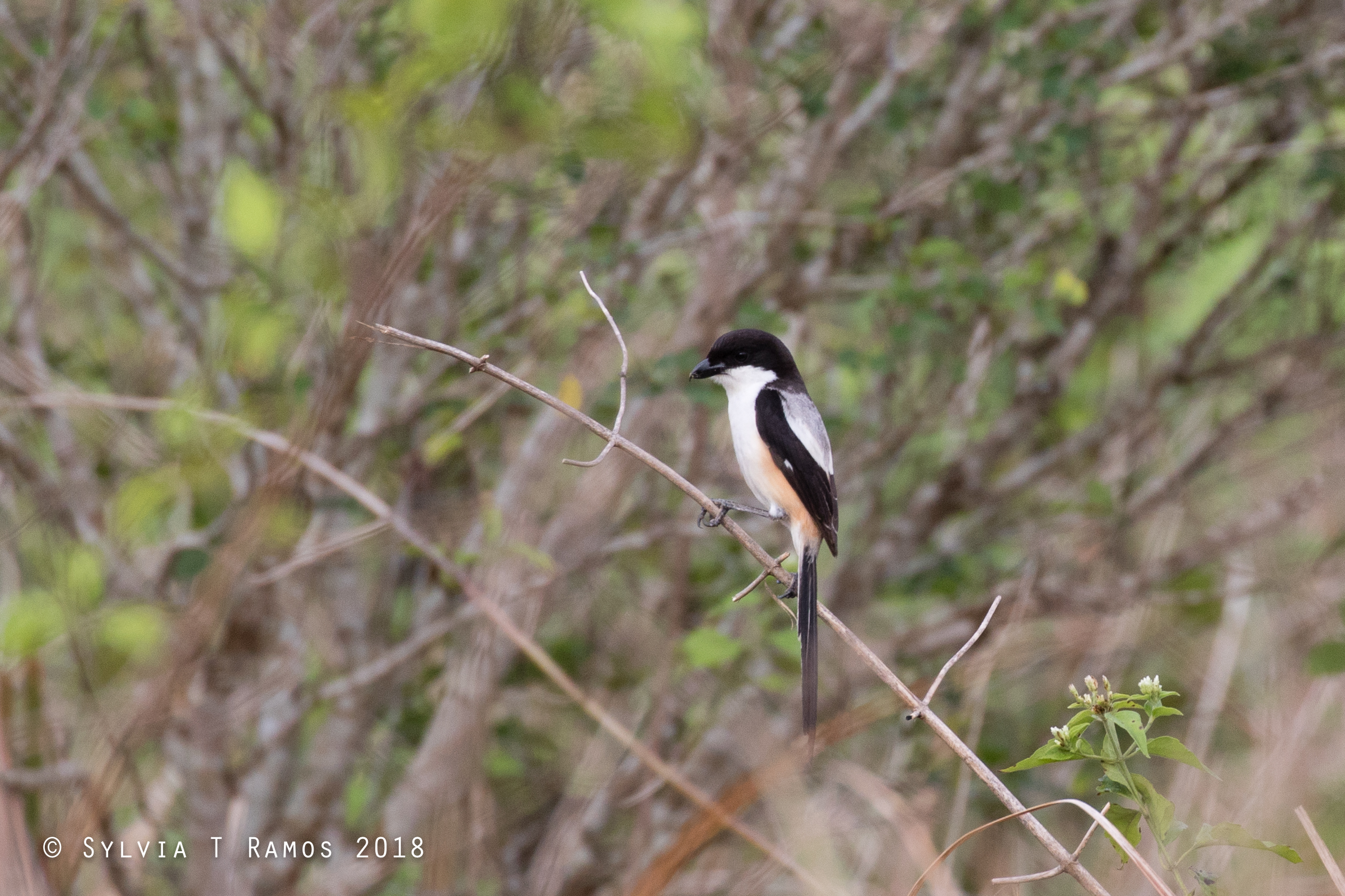
Some birds aren’t that scared of people and will hang out near the house. Like this cute little maya or Eurasian Tree Sparrow.
And then there are crows. I confess that I used to sit around thinking of schemes to get rid of the crows. Crows have a bad reputation. They eat other birds. They steal eggs from nests. Other birds mob them and try to drive them away. They are associated with witches and bad omens.
They are also very intelligent birds. They are part of the corvid family. There are studies that show corvids using all kinds of tools, remembering the faces of researchers at a university and then attacking them when they saw them in the campus, and solving complicated problems such as dropping pebbles into a container of water so they can get a sip of water just like the Aesop’s fable!
Now that I’m not scared of them or trying to drive them away, I can just watch them.
There’s a murder of crows that hangs out at the horse house.
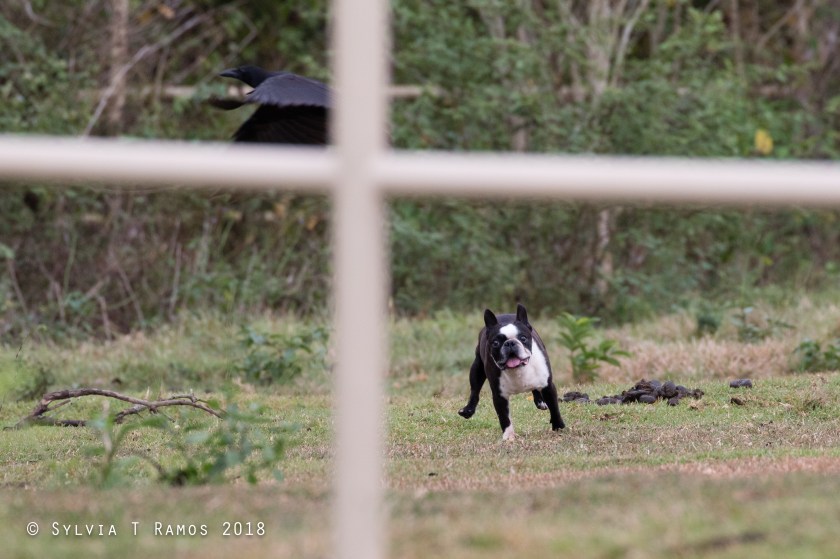
What would happen if Barkley entered the horse paddock? Would they attack Barkley?
Ha! Barkley didn’t even feel threatened.
They are no match for Barkley and just leave him to do his thing in the paddock.
I thought it was so nifty when I saw a crow drinking from the horses’ water trough. I ran back to the house so I could take a photo.
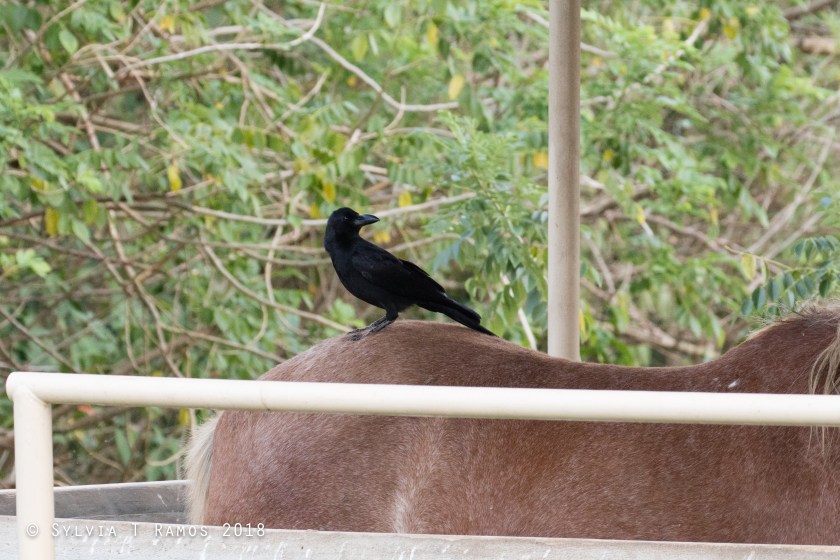
And then the other day I couldn’t believe my eyes. Was the crow really standing ON Takoy’s back?
Yes, he was! And Takoy wasn’t bothered at all!
The crow stayed there for a long time. What was going on? Was he going to groom Takoy? Get a bug from Takoy’s back like those Oxpeckers and Rhinoceros in Africa? Walk behind Takoy waiting for him to unearth bugs from the grass like a Cattle Egret and carabao? Grab some feed from Takoy’s bucket? I didn’t see anything like that, the crow just flew away. But who knows what I’ll see next time!
We are harnessing the power of water to restore, rehabilitate, and rejuvenate our property and make it more attractive to wildlife. One way to do this is to make a lot of ponds! The ponds catch and store rainwater so it can be used by plants and animals instead of just running off the land. We don’t use pond liners so that the water can eventually sink into the water table to recharge it.
We are making all sorts of ponds and trying different pond building techniques.
Our very first pond was built in February 2015. It’s our biggest and deepest pond. It was build by hand by 6 people. We wanted Pond No. 1 to be deep so it would hold more water for a longer time The deepest section is two meters deep.
The workers also built two smaller ponds near Pond No. 1. We learned from these smaller ponds that even smaller ponds can hold water for a long time. It’s not that necessary to make the ponds very deep.
In 2016 Tonji decided that he wanted to build the ponds himself. We bought a small backhoe. He built Pond #4 in March 2016. This pond has a small island in the center. It was very popular with the ducks last year! This pond was later renamed Secret Pond.
In 2017 we didn’t build any ponds. Tonji did some pond maintenance and enlarged Pond No. 3.
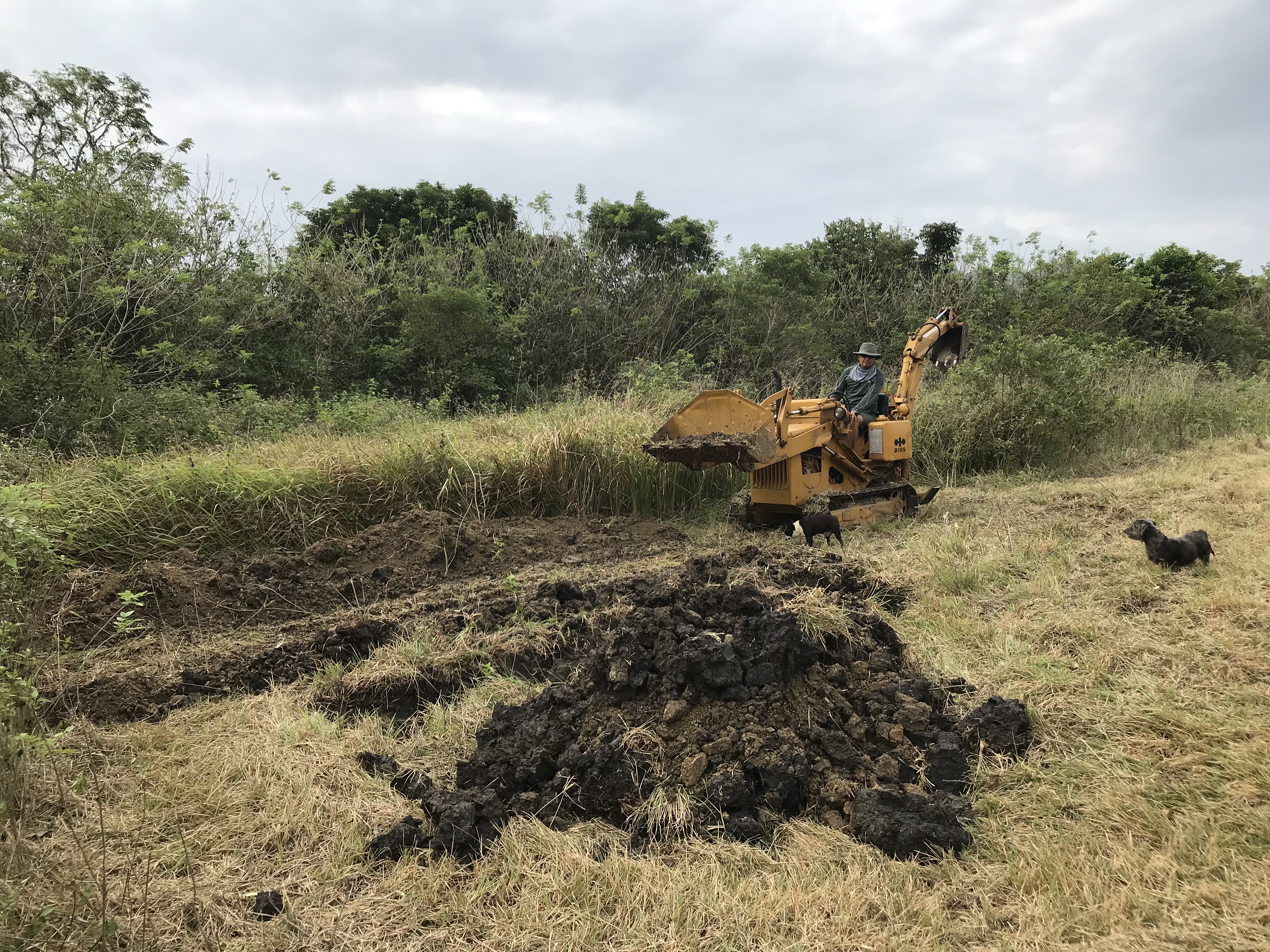
This year Tonji completed two ponds and is working on a third! It took him 9 days to build Pond No. 5. This pond has a back “wall” made up of mounded dirt that is supposed to hold water and add depth to the pond. At the other end it tapers out to a shallow overflow area. Tonji thinks his backhoe is equivalent to 4 men digging. This pond was finished quickly with the help of workers to move the dirt out and finish the sides by hand. This pond was later renamed Owl Pond.
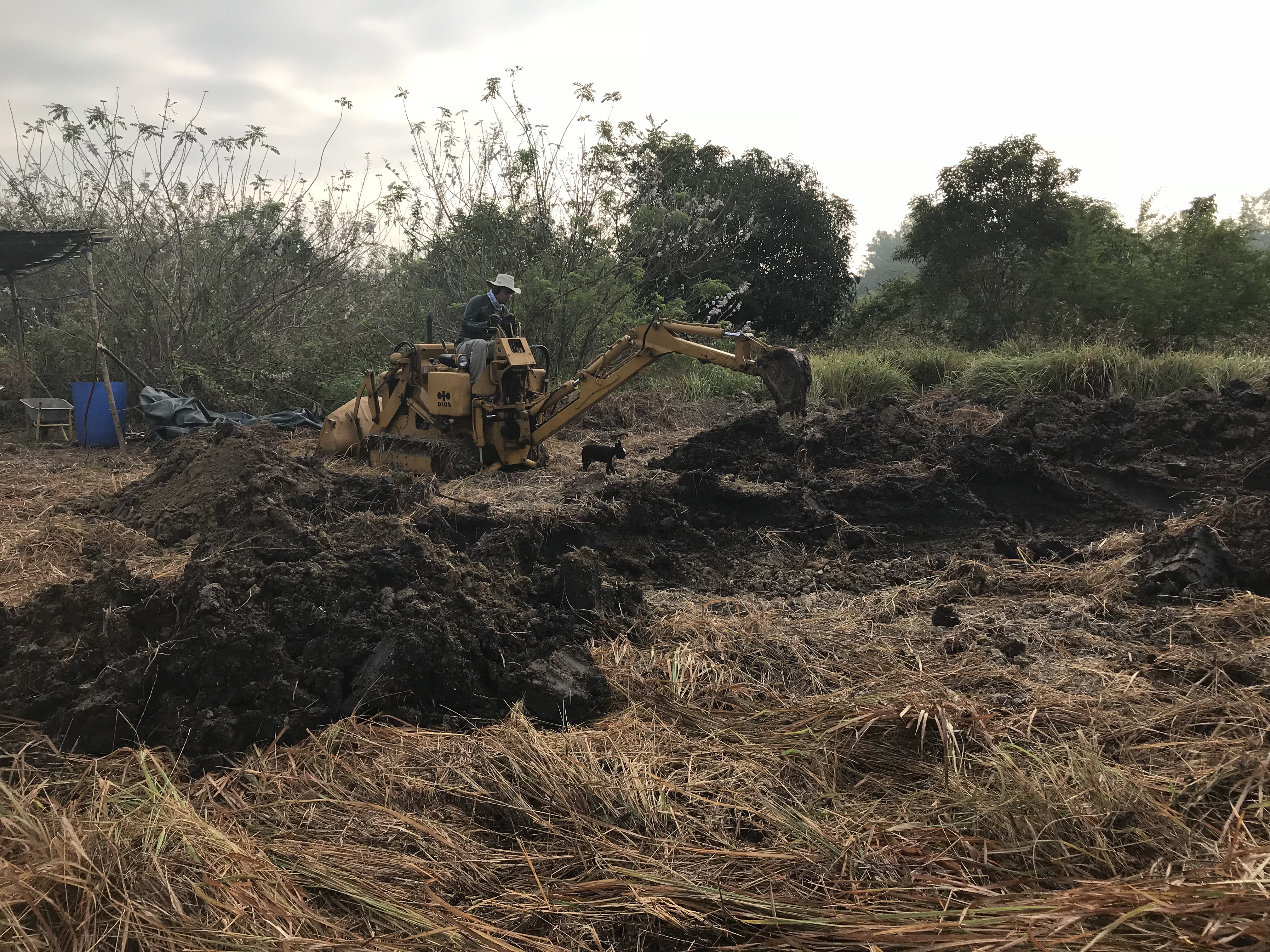
First he clears the grass with the grass cutterOops, stop digging while Barkely inspects the work!Momo’s turn to inspect the workPond No. 5 after one day of rain
Pond No. 6 took only two days to build! It is a small pond that Tonji hopes will provide water for the trees growing by the side. This pond was later renamed Picnic Pond.
start of Pond No. 6Pond No. 6 or Picnic Pond almost finished, will be tapered by hand
Pond No. 7 is still under construction. Tonji says this is going to be a big pond. This pond was later renamed Faraway Pond.
Day one of Pond No. 7 or Faraway Pond
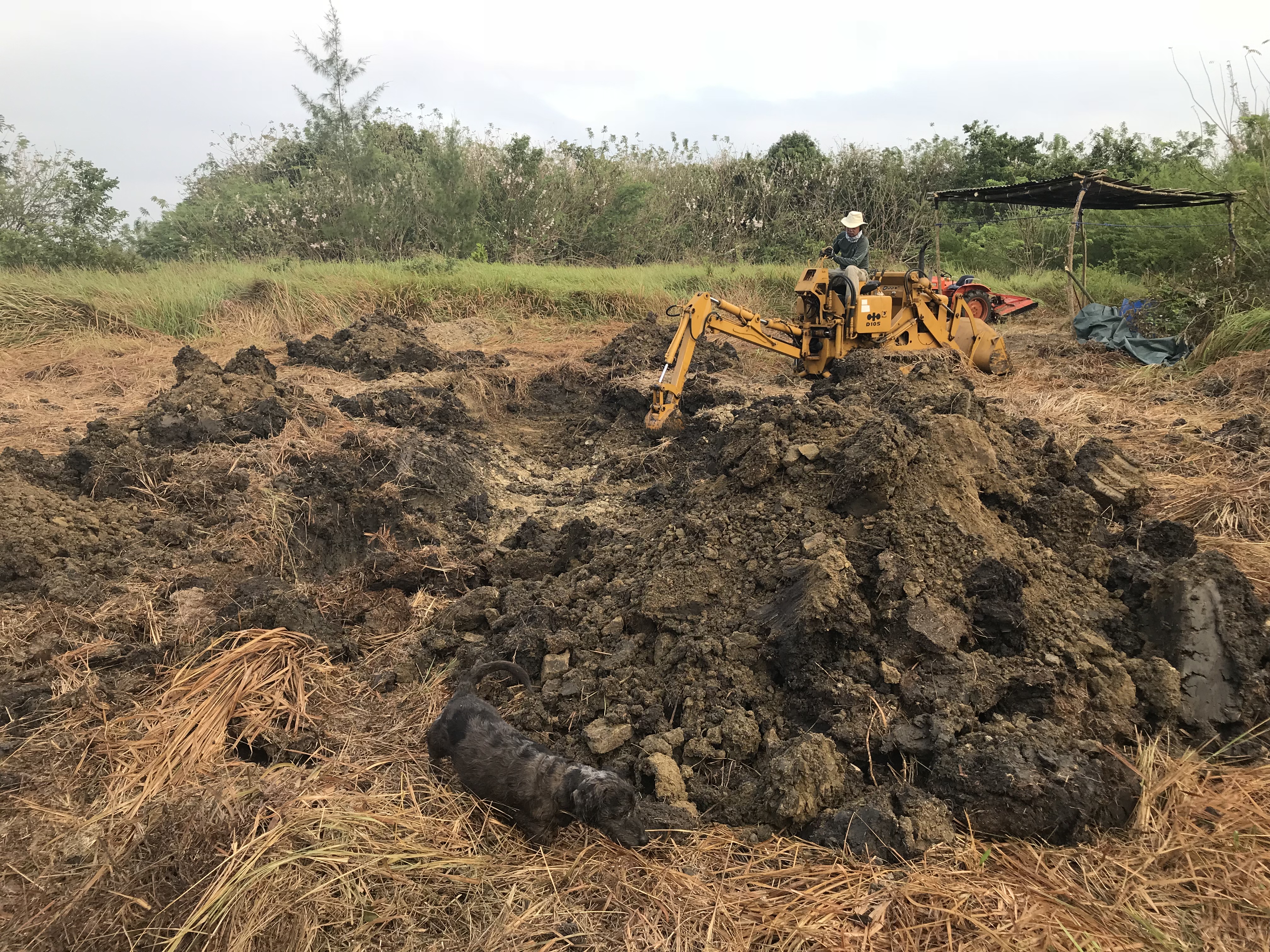
Tonji’s companion while digging for 3 days!
Pond Stats:
Pond No. 1
built from 25 Feb 2015 to 27 March 2015
current dimension: 17m x 8 m
Pond No. 2
built 2015
did not measure
Pond No. 3 (in 2019 Tonji said he doesn’t really count this as a pond) built 2015 current dimension: 7m x 4m
Pond No. 4 (now called Secret Pond) built March 2016 did not measure
Pond No. 5 (now called Owl Pond) built February 2018 in 9 days current dimension: 7m x 10m
Pond No. 6 (now called Picnic Pond) built March 2018 in 2 days current dimension: 6m x 5m
Pond No. 7 (now called Faraway Pond) started March 2018 still under construction
note: in 2019 we renamed the ponds. We retained the names of Pond #1 and Pond #2. The rest were renamed because I could not keep track of which pond was which!
My first Hagonoy Eradication Project Version was a failure. The good thing is, I now know why it failed! And I have a new and improved technique that works!
Version 1: Brute Strength and Fancy Tools
When I started the first Hagonoy Eradication Project in 2015, my goal was to find an efficient and safe method for removing hagonoy or Chromolaena odorata, an invasive weed that quickly spreads and can create a dense canopy that prevents other plants and seedlings from growing. It can even climb up small trees and overwhelm them. I thought that I could defeat the hagonoy with my brute strength and superior tools! Hahaha! I was mistaken.
For the first project site, I selected an open field that had many mature hagonoy plants growing in big clumps. I wanted to make a big impact by cleaning up the area with the biggest hagonoy plants. I thought the key was simply finding a big tool that could easily dig up the entire root of the hagonoy. When I found a great tool that could handle the big hagonoy roots, I thought that I had the solution to my hagonoy problems. I spent hours digging up hagonoy, only stopping out of exhaustion!
At first it looked like it worked. I was unprepared for when the hagonoy returned. Today, instead of big hagonoy clusters, there are many, many small hagonoy plants covering the entire field. Argh! There are so many of them that they are even harder to remove. The field looks even worse now than before I started.
November 2015, before it was cleared
November 2015, after it was freshly cleared
March 2018 – it’s worse! Lots of small hagonoy plants and a lot of Madre de Cacao
The only hagonoy-free areas are the paths that Tonji mows regularly. It seems that mowing with a grass cutter is an effective way to keep hagonoy out. Notice how the sides of the path are full of hagonoy and madre de cacao. The area also had an explosion of madre de cacao! I don’t know if it’s related to my hagonoy removal.
2018 – no hagonoy on the path. Just Barkley!
Version 2: Use Your Brain. And Fancy Tools Too.
In January 2017 I started version 2 of the Hagonoy Eradication Project. Instead of a big, open field I chose a much smaller, more manageable area. It is small area that is close to the cottage, easy to access, and is surrounded by trees.
While working on the new site, I noticed that the hagonoy growing inside the tree line is very easy to uproot. I realized that when hagonoy grows on good, soft soil with a lot of organic material like the soil found inside the tree line, it doesn’t spend a lot of energy on growing roots. Instead, it focuses its energy on growing leaves and branches. When the hagonoy is in open fields where the soil is usually more depleted, then it tends to send down longer and more tenacious roots.
I was on the right track with my new site! By choosing to work inside the tree lines, I can just sit in the shade of the trees and use a hand tool. Much less effort than standing in an open field and attacking the weeds with a huge weeder-shovel!
This is Hagonoy Eradication Site #1. The brown area in the middle used to be a small patch of tall grass that Tonji mowed. There are different kinds of seedlings planted along the edge of the tree line. Most of the hagonoy at this site is gone. The site still requires some maintenance. There are small hagonoy plants that need to be pulled out. I think there were a couple of hagonoy that flowered in December and I wasn’t able to pull them out before they went to seed!
On the whole, I think this site is successful. It is in the stage where other plants are coming up in place of the hagonoy!
This is called Kandikandilaan. It was already present at the site and has spread even more. It attracts a lot of butterflies.
Stachytarpheta indica
We call this Limang Sugat. I never noticed this at the site before, but now there is a big patch of it there!
Pseuderanthemum bicolor
The most exciting part — the tree seedlings that just came up by themselves! Before, this was just a blanket of hagonoy that choked out everything else. Now we now have different kinds of plants coming up including new trees!
The first seedlings to show up in the area were Ipil Ipil or Leucaena leucocephala. I removed them and the tree they came from because they are a weed-like tree that can quickly form a dense thicket that blocks out all other plants.
Not sure what this is. Hauli?
This is Hagonoy Eradication Site #2. It’s a line of trees in between the horse paddock and compost area. We also planted trees along the tree line. I will work on this site while the soil is still soft and easy to dig.
lots and lots of hagonoy!
This is a cleared section. The Talisay trees we planted are now free from the hagonoy that was choking them and blocking their light. Other things can now sprout from the ground. I used to drag the hagonoy out to the path so they would shrivel up and not suddenly spring back to life. Now I leave the hagonoy on the ground where they fall so they can serve as mulch.
I’m also going to try this tool and see if it’s easier to use than my hori hori knife.
Phase 2 – The Chipper!
In a few months when it’s summer and the ground is hard and dry, I will start Phase 2 of hagonoy eradication. Chop and drop time! There are a lot of dried branches and madre de cacao trees in the area that I can turn into wood chips. I will cover the areas around the trees with a thick layer of wood chips. This will improve the soil even more, make the trees grow better, and make any hagonoy that grows even easier to remove. As a bonus, the roots of the madre de cacao trees that were cut will die back and become water channels. This is good for the trees other remaining trees. Soon, hard, dry, weedy soil will be a thing of the past. We will have soft, moist, hagonoy-free ground!
Hagonoy Eradication for Reforestation
There are many more areas with hagonoy at the sanctuary. I will continue to focus my hagonoy removal efforts combined with mulching with wood chips on the areas that already have trees and seedlings that we planted. This aligns with a method of reforestation called ANR or Assisted Natural Regeneration where instead of just focusing on planting trees, you also remove or suppress weeds to encourage naturally occurring wildings to survive. Removing the hagonoy in those areas will encourage the forest-like areas to expand and grow.
ANR is a method for enhancing the establishment of secondary forest from degraded grassland and shrub vegetation by protecting and nurturing the mother trees and their wildlings inherently present in the area. ANR aims to accelerate, rather than replace, natural successional processes by removing or reducing barriers to natural forest regeneration such as soil degradation, competition with weedy species, and recurring disturbances (e.g., fire, grazing, and wood harvesting). Seedlings are, in particular, protected from undergrowth and extremely flammable plants such as Imperata grass. In addition to protection efforts, new trees are planted when needed or wanted (enrichment planting). With ANR, forests grow faster than they would naturally. – from http://www.fao.org/forestry/anr/en/